Poeh Cultural Center • Smithsonian’s National Museum of the American Indian • Long-Term Partnership Loan • Opened Fall 2019
⸻ The Return Home
A Century Away.
A Homecoming.
For more than 100 years Tewa Pueblo ancestral pottery has been collected, shipped away and housed on the east coast, largely in private collections and the renowned Smithsonian Institution’s National Museum of the American Indian (NMAI).
Several years ago, the Poeh Cultural Center began talks with NMAI, in a concerted effort to bring these pots “home.” Along the way, many Tewa Pueblo artists, elders and community members worked tirelessly to help bring this homecoming to fruition.
It’s time to celebrate this achievement. In fall 2019, after a century-long and epic journey, this sacred ancestral pottery will be reunited with the descendants of the creators, to be housed and displayed at the acclaimed Poeh Cultural Center.
A Circular Journey
Late 1800s – Early 1900s
Tewa ancestral pottery is collected from the six Tewa-speaking Pueblos and shipped to institutions and private collections on the East Coast.
2016
Poeh Cultural Center and NMAI begin formal planning for a long-term loan of 100 Tewa pots.
2016 – 2019
Tewa Pottery Advisors make multiple visits to NMAI’s Cultural Resources Center in Suitland, MD to select, study, and help prepare the pottery for its return.
2017
An initial loan of nine ceramics opens as T’owa Vi Sae’We (The People’s Pots) — the first homecoming exhibition.
Fall 2019
Di Wae Powa: They Came Back opens at the Poeh Cultural Center. One hundred Tewa ancestral vessels are reunited with their people.
Ongoing
The exhibit continues as a living cultural resource and co-stewardship model — open to the community, researchers, and the world.
⸻ Cultural Context
The Role of Pottery in Tewa Life
Since time immemorial, pottery has been a living language — speaking of place, presence, purpose, and generations of ancestral connection.
Our Place of Origin
The creators of this pottery are of the Tewa-speaking Pueblos of the Rio Grande North: Ohkay Owingeh, Santa Clara, San Ildefonso, Nambé, Pojoaque, and Tesuque. Within a Pueblo, the potter serves every dimension of community life — ceremonial use, daily cooking and storage, and spiritual practice.
Pottery making has been handed down from generation to generation
The Spiritual Life of Clay
For the Tewa potter, clay is not a material — it is a living being. Every clay gathering site belongs to a community, and gathering begins with spiritual connection and an offering of thanks. The clay is acknowledged as physical, living, and breathing.
At the moment of contact, the potter becomes parent and guardian. The journey from clay to vessel mirrors the journey of life: birth, growth, nurturing, and purpose. Even the pigments and slips are reflections of Mother Earth.
⸻ Making & Knowing
Pottery & Process
In the process of working clay, things struggle to become circular — and encourage a return to places of origin.
The pottery-making process is not merely technical. It is a sustained relationship between the potter, the land, and the community — across time. Understanding this process enriches engagement with every vessel in Di Wae Powa.
- Clay GatheringThe potter returns to gathering sites, gives thanks, and asks permission. Clay is dug from natural clay deposits and gathered by hand for processing.
- PreparationClay is dried, then soaked, sieved, and mixed with temper — often pulverized sherds from broken pots.
- BuildingCoils are stacked and smoothed around a puki (a small turning dish) to build the walls. The work is slow, circular, and attentive.
- FinishingThe dried pot is sanded, slipped with a suspension of clay and water, then burnished with a polishing stone until it sings. The potter may paint distinctive designs before firing.
- FiringPots are fired outdoors in a wood-heated fire.
Impact
Since time immemorial, pottery has been a living language — speaking of place, presence, purpose, and generations of ancestral connection.
Cultural Revitalization

The return of ancestral pottery inspires active participation in pottery-making traditions, Tewa language practice, and the renewal of cultural identity across all six Tewa-speaking Pueblos.
Youth Education
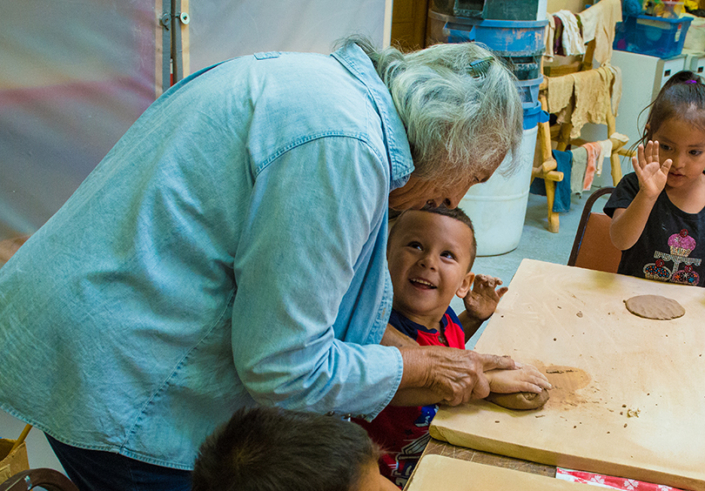
From early childhood visits to hands-on pottery workshops with Tribal teens, Di Wae Powa gives Pueblo youth the experience of encountering their ancestral heritage and the living traditions that surround it.
Tribal History Research
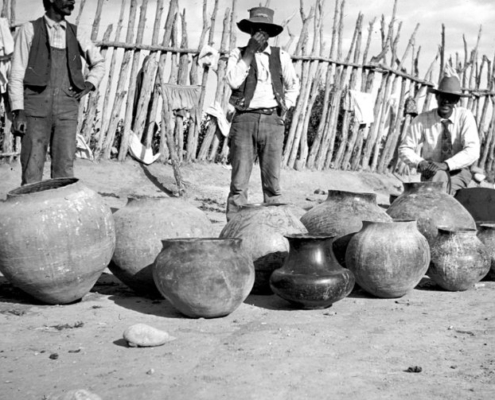
Di Wae Powa has inspired the Poeh Cultural Center to continue researching historic Pojoaque pottery collections and their histories across museum and institutional holdings.
Community Committee
Tewa Pottery Advisory Committee
Clarence Cruz (Ohkay Owingeh)
Elvie Aquino (Ohkay Owingeh)
Michael Bancroft (Ohkay Owingeh)
Erik Fender (San Ildefonso Pueblo)
Evone Martinez (San Ildefonso Pueblo)
Brandi Martinez (San Ildefonso Pueblo)
John Garcia (Santa Clara Pueblo)
Cris Velarde (Santa Clara Pueblo
Tessie Naranjo (Santa Clara Pueblo)
Eliza Naranjo Morse (Santa Clara Pueblo)
Shawn Tafoya (Santa Clara Pueblo)
Bea Duran (Tesuque Pueblo)
Lonnie Vigil (Nambe Pueblo)
Martha Romero (Nambe Pueblo)
Josephina Villarreal (Pojoaque Pueblo)
Sam Catanach (Pojoaque Pueblo)
Tewa Community Participants
Gilbert Sanchez (San Ildefonso Pueblo)
Catherine Trujillo (San Ildefonso Pueblo)
Kathy Sanchez (San Ildefonso Pueblo)
Augustine Calvert (Santa Clara Pueblo)
Jody Folwell (Santa Clara Pueblo)
Gloria Garcia (Pueblo of Pojoaque)
Thelma Talachy (Pueblo of Pojoaque)
Joe Talachy Sr. (Pueblo of Pojoaque)
Melissa Talachy (Pueblo of Pojoaque)
Francine Maestas (Pueblo of Pojoaque)
David Trujillo (Pueblo of Pojoaque)
Shawn Tafoya’s Poeh Pottery Class
Michael Brancroft’s Poeh Pottery Class
Pueblo of Pojoaque Boys & Girls Club
Pueblo of Pojoaque Early Childhood Center
Poeh Cultural Center
Karl Duncan (Executive Director)
Reuben Martinez (Operations Director)
Stephen Fadden (Program Director)
Lynda Romero (Collections Manager)
Jake Viarrial (Tourism Coordinator)
Macario Gutierrez (Archives Manager)
Pueblo of Pojoaque
Joseph Talachy (Governor)
George Rivera (Former Governor)
Adam Duran (Tribal War Chief)
Bruce Bernstein (Tribal Historic Preservation Officer)
National Museum of the American Indian
Cynthia Chavez Lamar (Assistant Director of Collections)
Tessa Shultz (Assistant Project Manager)
Beth Holford (Conservator)
Shelly Uhlir (Mountmaker)